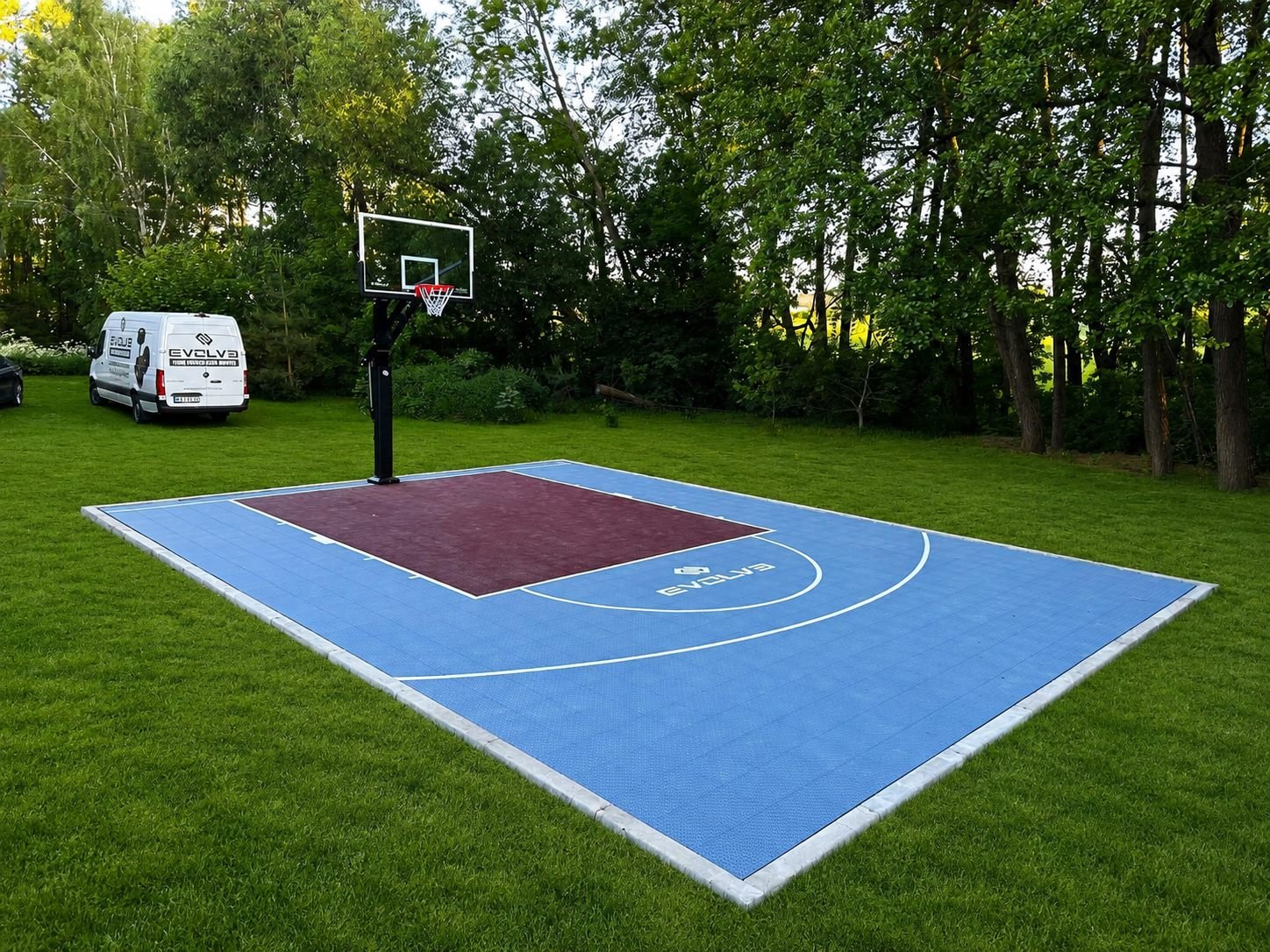
A backyard court is five decisions: how big, which stand, what base, which surface and which colours. Make them in this order: the size decides where the base goes, and the stand decides whether the base needs a foundation.
1. Choose the size
Measure the free, level space you have. Evolve courts come in three sizes, each with the measurements the area needs:
- Backyard court, 81 m² – 10.47 × 7.71 m. Enough for shooting and one-on-one games. See the 81 m² court.
- Half court, 153 m² – 15.07 × 10.16 m. A full key and the three-point line. See the 153 m² court.
- Full court, 470 m² – 28.86 × 16.28 m, with a basket at each end, for schools, communities and large plots. See the 470 m² court.
In the 3D court builder you can try each size with your colours and stand before you decide.
2. Choose the stand
- EV-BS-PT-140 – a portable stand where an in-ground stand cannot go. No foundation: its base (130 × 82 × 20 cm) takes up to 160 kg of water, and it moves on wheels. Rim height 230–305 cm.
- EV-BS-IG-140 – an in-ground stand with a 1360 × 800 mm tempered glass backboard and Twist-n-Set height adjustment from 230 to 305 cm. It needs a concrete foundation.
- EV-BS-IG-AH-180 – the heavy-duty in-ground stand: a 1805 × 1050 mm board of 12 mm glass, rim height from 167 to 305 cm (from children to adults), 225 kg. It also needs a concrete foundation.
Plan for the board’s projection: the board stands 60 cm (EV-BS-PT-140, EV-BS-IG-140) or 120 cm (EV-BS-IG-AH-180) in front of the post, so the post goes behind the baseline.
3. Prepare the base
The surface can be laid on compacted ground, concrete or asphalt. The most economical base is compacted crushed stone: it costs less than asphalt and does not crack the way asphalt does after a few years.
- Crushed stone without clay or loam, compacted in layers to the design thickness and wetted while compacting; the top layer of stone sand.
- Kerbs set in wet concrete round the court, at least 3 cm above the last compacted layer.
- A level surface, without dips or waves.
- Black 150 g/m² non-woven geotextile on top, so fine soil does not come up through the tiles.
Your contractor decides whether drainage is needed, from the soil, the levels and the ground water. Preparing the base, and the foundation of an in-ground stand, is not part of an Evolve court package: you prepare them, or we recommend a contractor.
4. Choose the surface
Both Evolve surfaces are interlocking 30.48 × 30.48 cm tiles with double locks on every side, laid loose, without glue. Rain drains through the perforated tiles, so the court can be played on right after rain, with no slopes or drainage channels needed.
- EV-FL-PP – polypropylene, 1.8 cm, grey or brown. The surface of the Evolve court packages.
- EV-FL-TP – thermoplastic, 1.4 cm, blue or green. Absorbs impact better and stays elastic in winter.
The tiles expand in heat and shrink in cold, so a 2–6 cm gap is left at the kerbs and round the stand, and they are never fixed to the base.
5. Colours and lines
The court and the key can be in different colours – the packages are a grey court with a brown key – and the lines are marked in white or yellow. Lines for other sports, colour combinations and logos are possible too.
6. Installation
When the base is ready, our team lays the tiles, marks the lines and assembles the stand, ready to play. A fence round the court is worth considering: it stops balls and protects the surface from strong wind.
In short
- Measure the space and choose the size.
- Choose the stand: portable, or in-ground with a foundation.
- Prepare the base (and the stand’s foundation).
- Choose the surface and colours – try them in the 3D builder.
- Send us the design: we will reply with a quote and lay the court.